DM3 is how every Strata Logic client gets monitored.
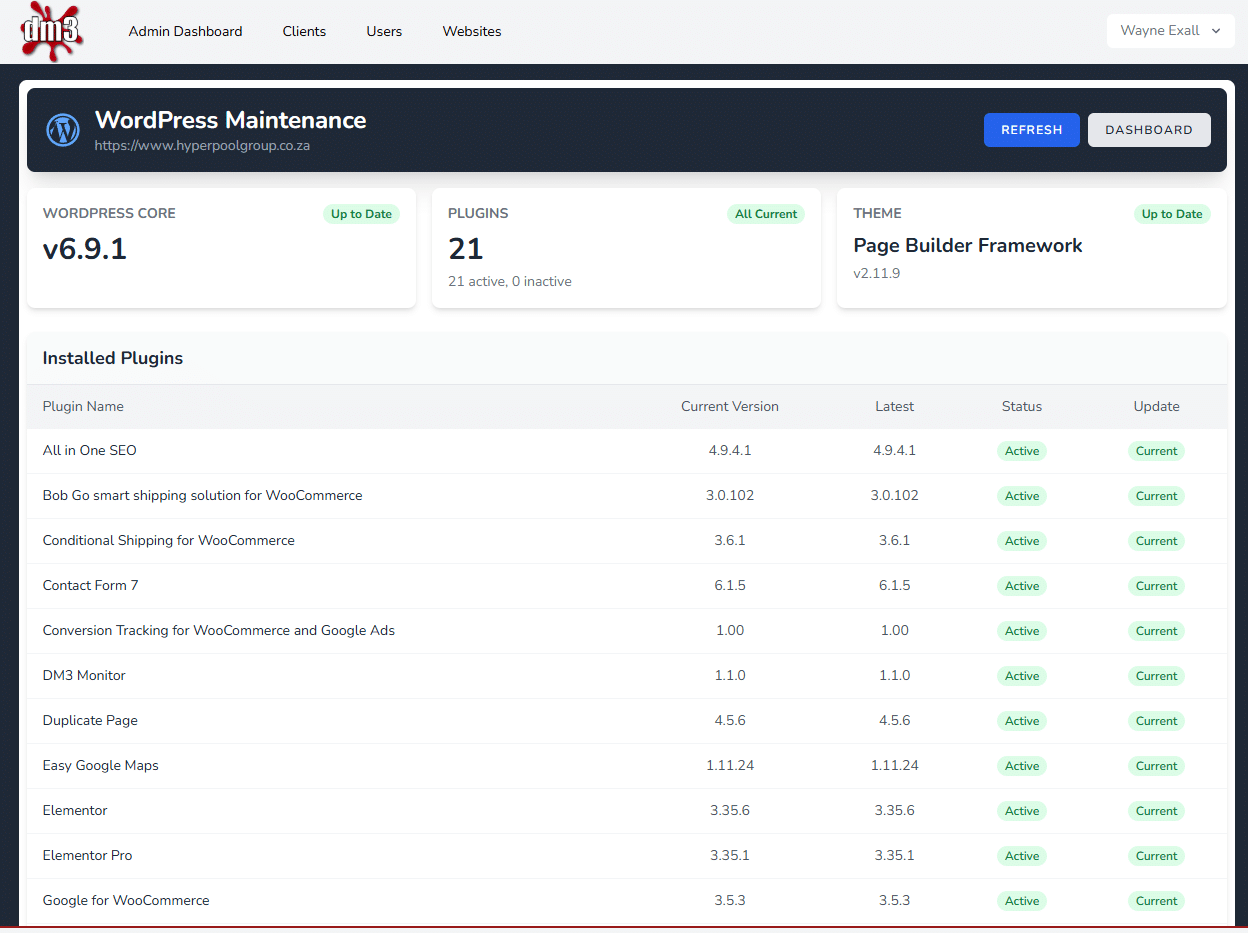
Our own multi-tenant SaaS, live since February 2024. Aggregates 10+ external APIs into one dashboard per client: uptime, PageSpeed, Core Web Vitals, GA4, Search Console, ad spend, SSL, DMARC, WHOIS. Every client signs in to their own slice.
What we built
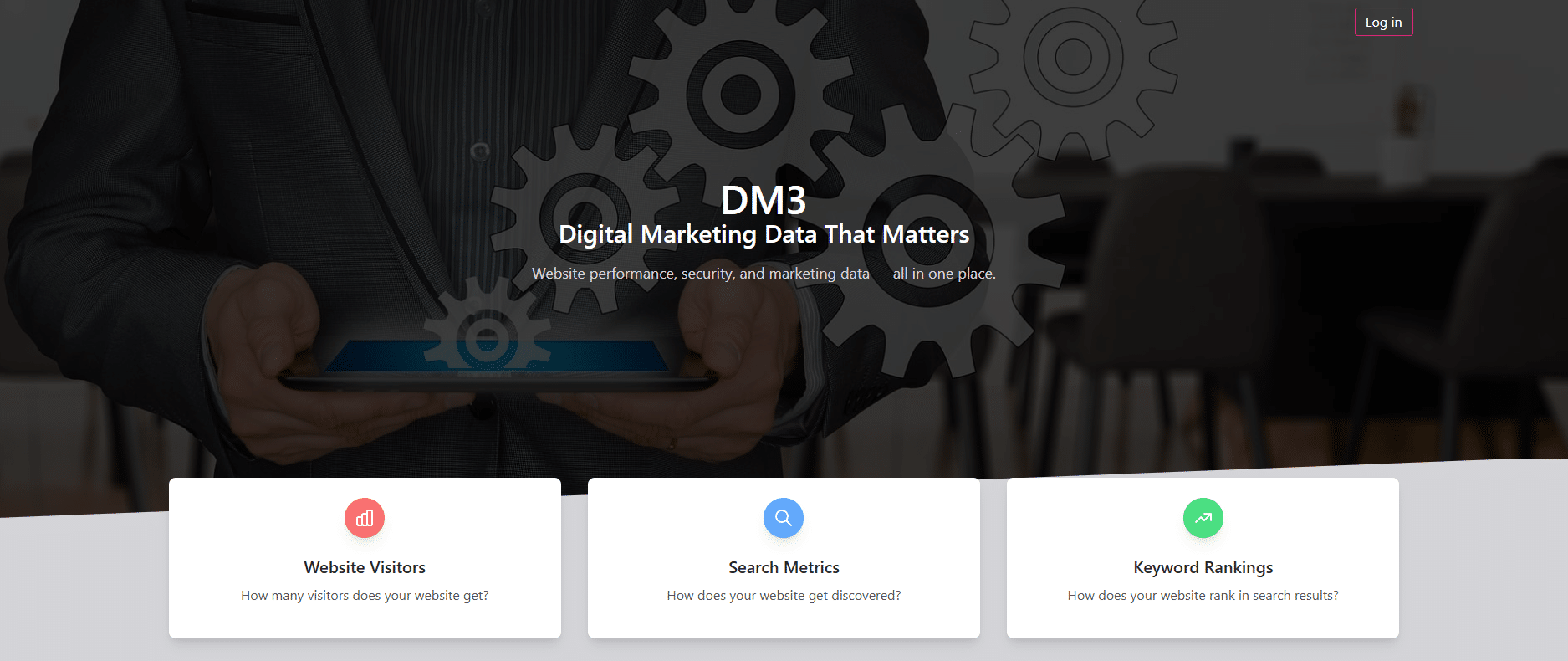
DM3 is our own multi-tenant monitoring platform, the one piece of software we build for ourselves and run for every Strata Logic client. It aggregates ten-plus external APIs into a single dashboard so we can see uptime, performance, search, ad spend, email security and domain health side by side, per website, without flipping between half a dozen vendor tools. Every client signs in to their own slice; we sign in once and see the whole book.
-
Multi-tenant SaaS
Twenty-one database models cover users, clients, websites, analytics, Lighthouse scores, uptime checks, DMARC reports, ad spend, cost items, services, quotes and invoices. Twenty-five Livewire components drive the UI. Per-tenant data isolation is enforced at the route layer, and role-based access splits the platform across Admin, Reseller and Client.
-
Four-tab dashboard
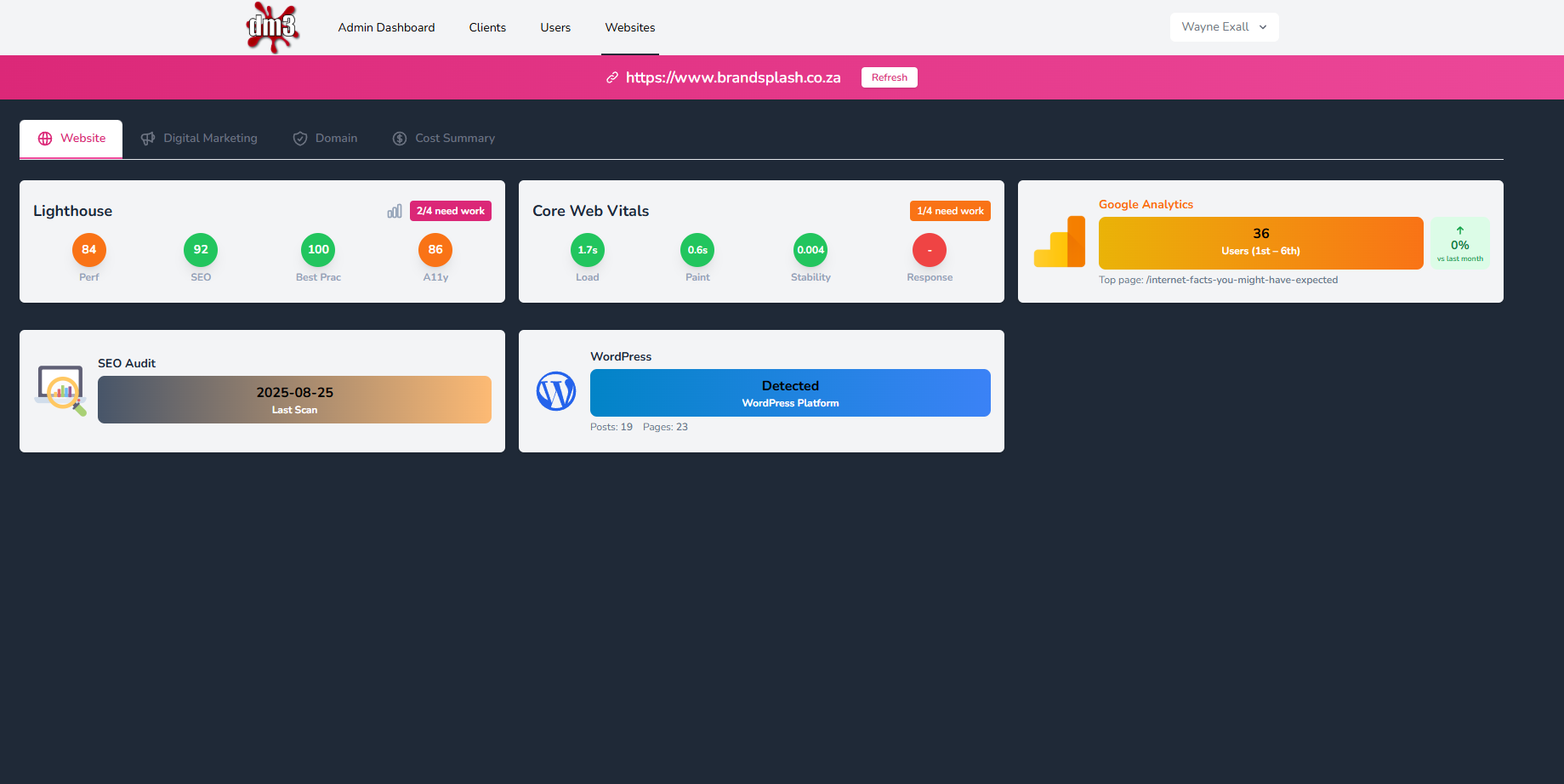
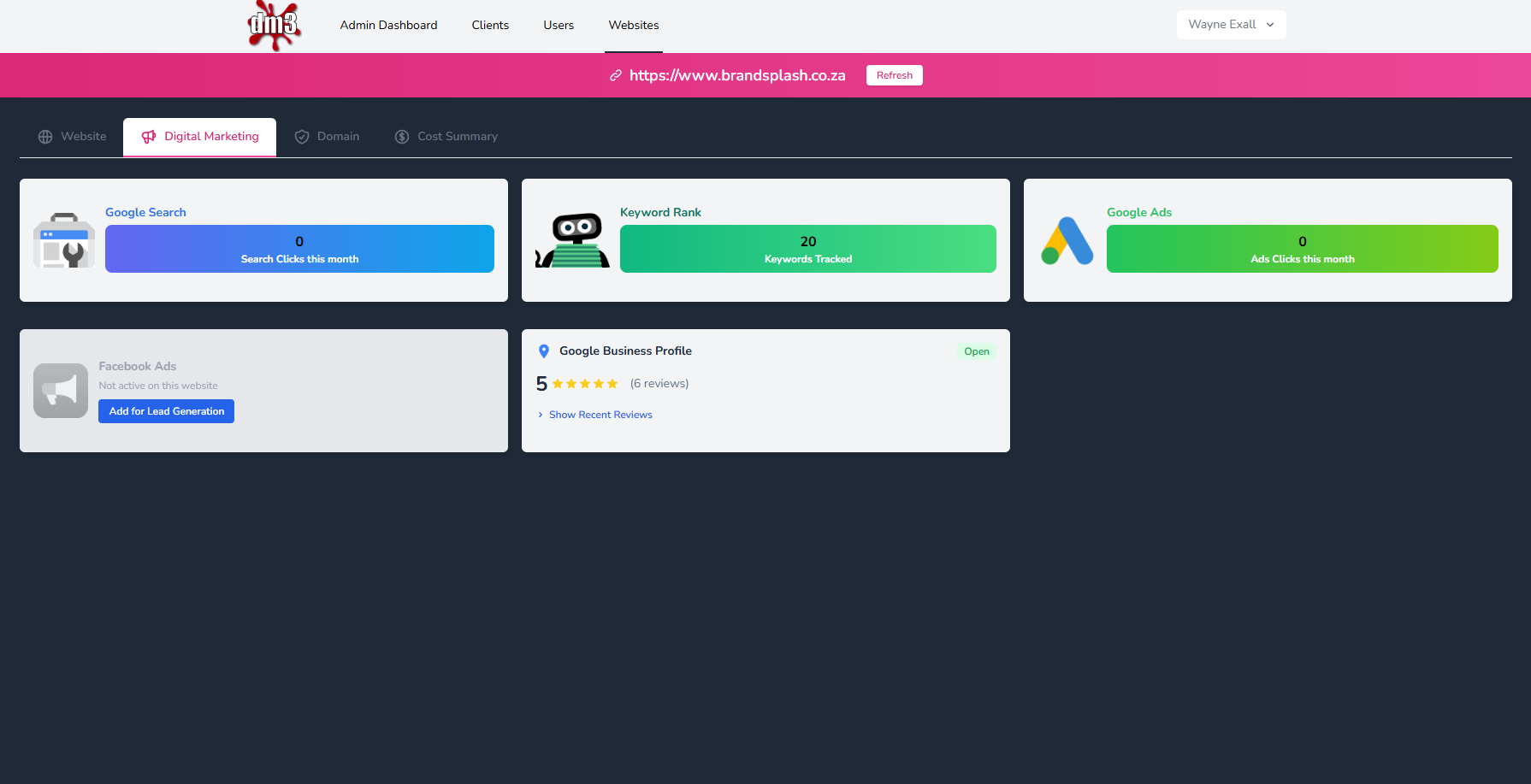
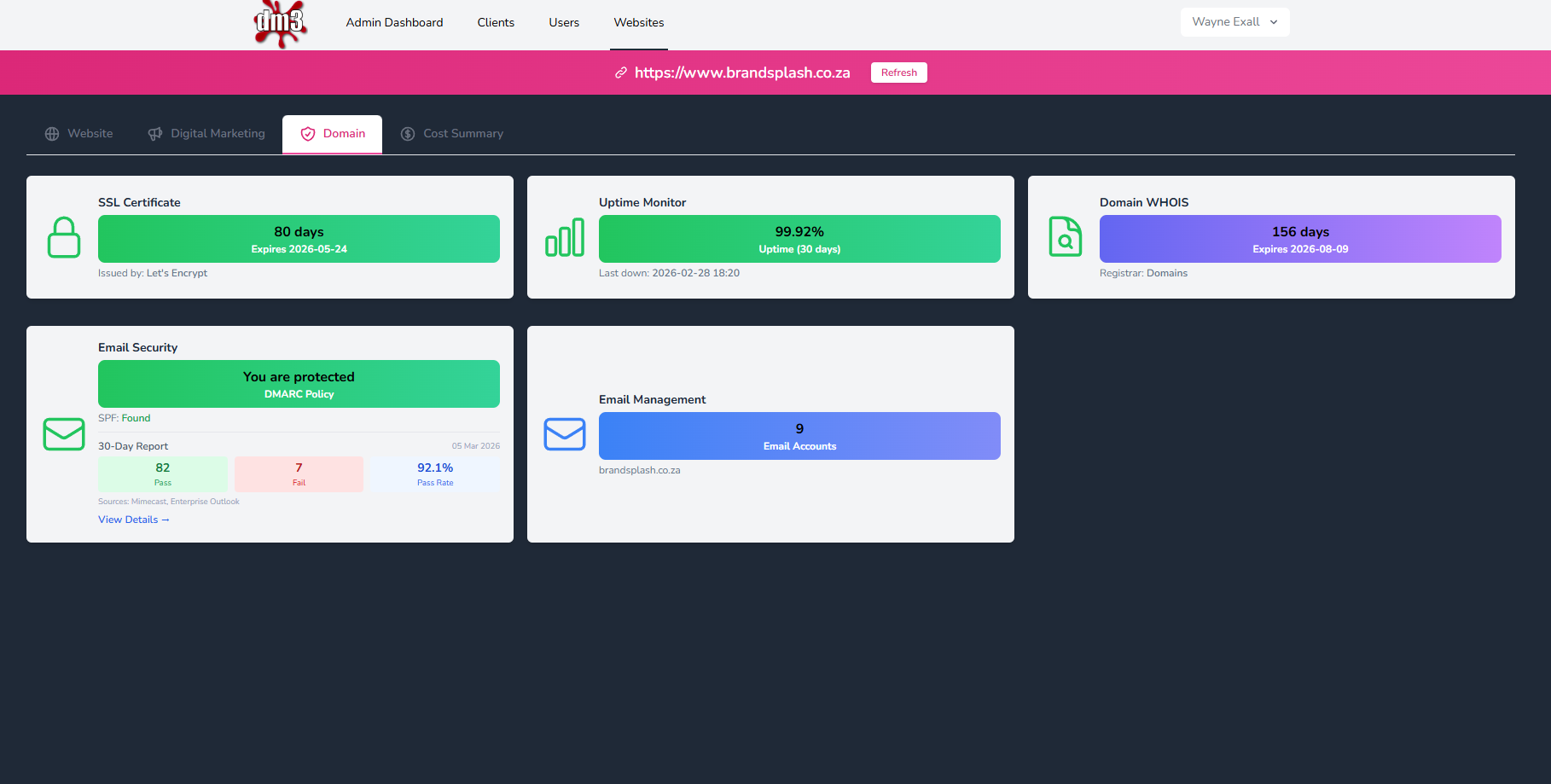
Every website rolls up into four tabs: Website Performance, Digital Marketing, Domain & Security, and Cost Summary. Each client sees only their own data, but the structure is the same across the book. Admins and resellers move between client dashboards without changing tools.
-
10+ API integrations
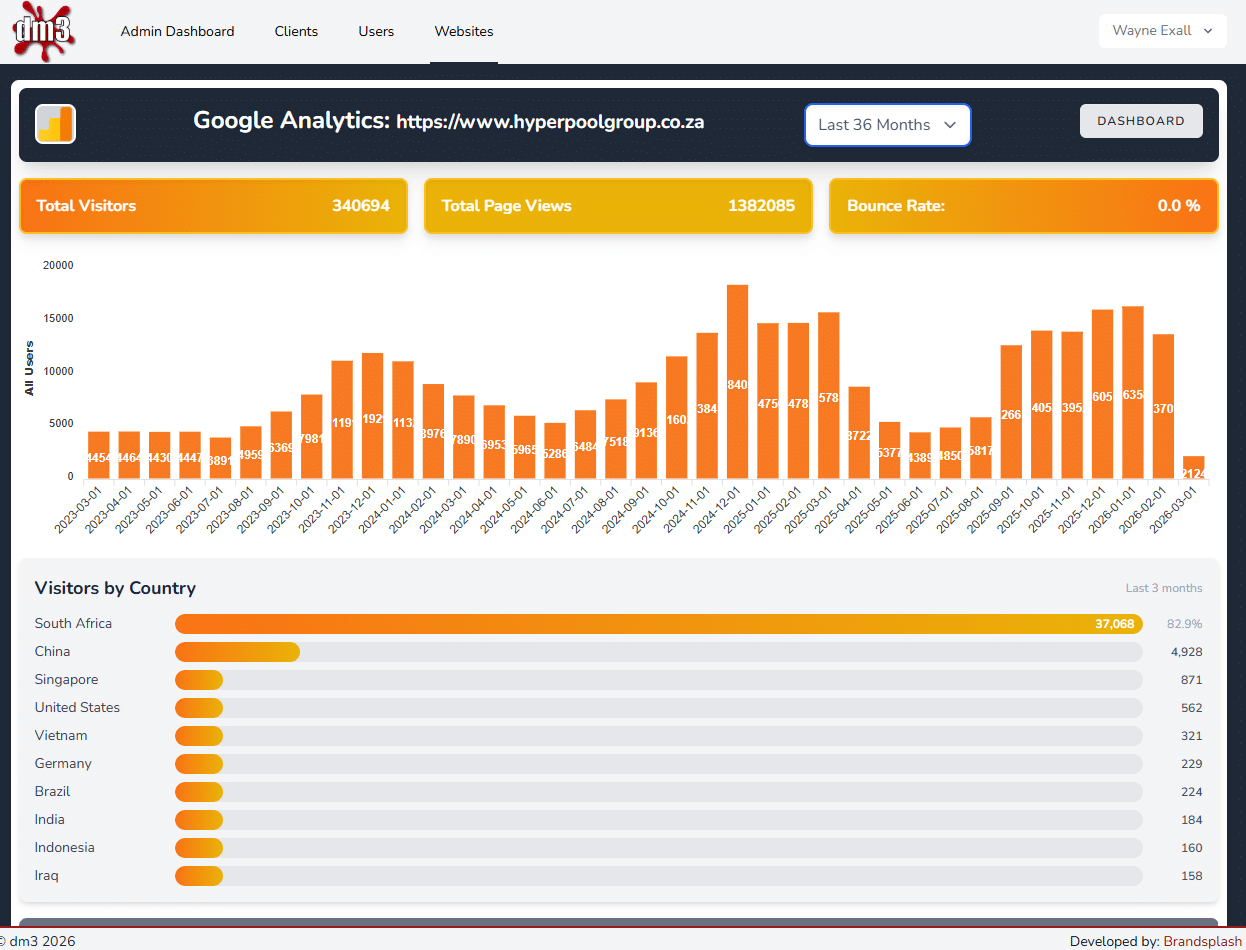
Google Analytics 4, Search Console, Google Ads, Facebook Marketing, PageSpeed Insights, SerpRobot, WHOIS, SSL, DMARC, cPanel UAPI and WordPress REST all feed the same dashboard. Each source is cached with a TTL between one and twenty-four hours, sized to the volatility of the data and the rate limits of the upstream API.
-
Automated monitoring
Uptime is checked every five minutes. PageSpeed and Lighthouse run weekly. DMARC aggregate reports are parsed daily out of an IMAP mailbox. Google Analytics data refreshes weekly. The monitoring loop is cron-based scheduled tasks, not a long-running daemon. It is simple to operate and easy to reason about.
-
Authentication + RBAC
Jetstream handles authentication, with optional two-factor. Sanctum issues API tokens. Spatie Permission carries the Admin / Reseller / Client roles. A user-property middleware sits on every website-specific route so a client can never see another client's information. Tenant isolation is enforced before the data layer is touched.
-
Public audit tools
The public-facing SEO scan and security scan tools are hosted by DM3 itself. They run as rate-limited public endpoints: lead magnets that pull prospects into the funnel while sharing the same codebase and infrastructure as the production platform. One stack, one set of integrations, two audiences.
Outcomes
Since Feb 2024
In production
10+ API integrations
Unified dashboard
5-minute
Uptime check interval
Common questions
Why build instead of buy?
What does DM3 monitor?
How does multi-tenancy work?
What runs the production stack?
How is caching handled?
Are the public audit tools the same platform?
Stack
The platform runs on Laravel 11 with Livewire 3, PostgreSQL as the production database, and Apache with PHP 8.3-FPM. Authentication is Jetstream with optional two-factor, Sanctum issues API tokens, and Spatie Permission carries the Admin / Reseller / Client roles. Twenty-one database models and twenty-five Livewire components make up the application surface.
Built entirely in-house. No third-party partner. DM3 is the operational core of Strata Logic.
DM3 has been live since February 2024 and is the operational backbone of the agency. It is not a side project or a marketing demo. It is how we monitor every client website, every day. Uptime, performance, search, ad spend, email security and domain health flow into one platform so we can see problems before clients notice them and answer questions without logging into half a dozen vendor consoles. The site you are reading is one of the things DM3 watches.
Want a custom platform built for your operation? See custom platform development →